
🏅 How long must one wait for the world to recognize true contributions? Or perhaps the deeper question is: what makes the pursuit of knowledge worthwhile even when recognition remains elusive?
Sometimes, breakthroughs in one field ignite revolutions in another, compelling the world to appreciate the brilliance that transcends boundaries. This year’s Nobel Prize in Physics is a testament to two such pioneers—whose work not only shaped Artificial Intelligence but also bridged physics, biology, and cognitive science.
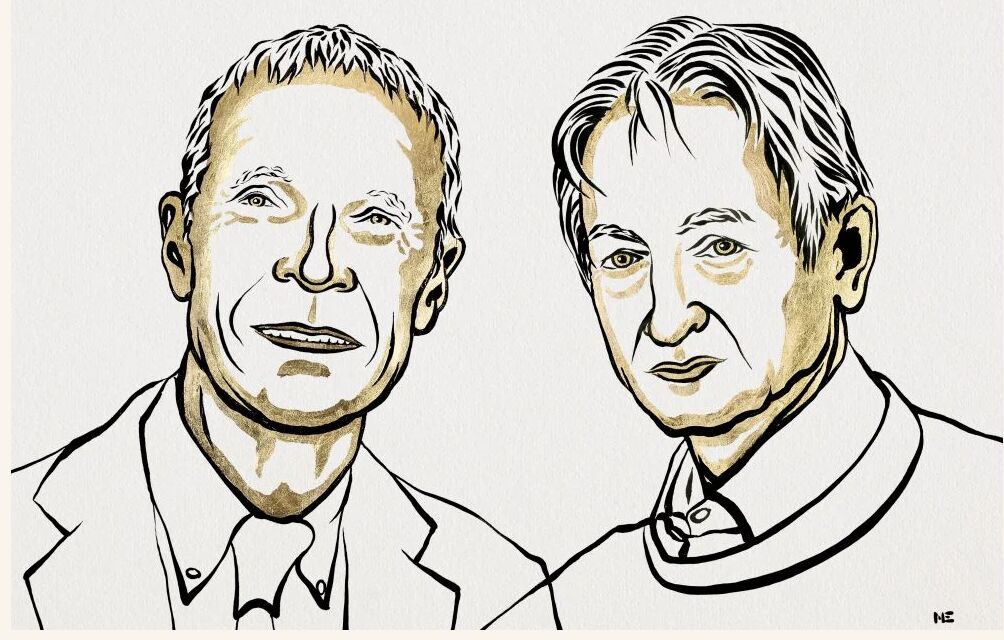
🎉 John J. Hopfield, now a Professor of Physics at Princeton, has made pivotal contributions across fields—from Physics to Chemistry and Molecular Biology, and establishing a PhD program in Computational and Neural Systems. In 1983, he introduced the Hopfield Network—a dynamic system that stores and retrieves memories using energy minimization principles from physics. What began as an abstract model is now the foundation of associative memory in AI.
🚀 Geoffrey Hinton, often celebrated as the ‘Godfather of AI’ and a trained cognitive psychologist, built on Hopfield’s work to create the Boltzmann Machine. His 1986 breakthrough—the Backpropagation Algorithm—paved the way for training deep neural networks. In 2012, Hinton transformed image recognition with AlexNet, an eight-layer deep network that sparked the modern deep learning era. His groundbreaking achievements earned him the Turing Award, often referred to as the “Nobel Prize of Computing.”
📚 Having spent more than three decades teaching the contributions of visionaries like Hopfield and Hinton, it’s gratifying to see their work acknowledged at the highest level.
Their journey to the Nobel teaches us:
🔥 Recognition is not the goal.
🌟 Pursue knowledge for its own sake, for one day it may illuminate paths no one could have imagined.
Beyond his technical mastery, Geoffrey Hinton has become a vocal advocate for Ethical AI, urging us to build these systems responsibly. His decision to step down from Google to “freely speak out about AI’s dangers” is a reminder that even the most advanced technologies must align with human values.
As Hopfield’s focus on energy minimization in physical systems comes full circle, it may inspire new ways to reduce the energy footprint of today’s resource-intensive Large Language Models that power modern AI.
Hopfield, at 91, and Hinton, at 77, remind us that true brilliance transcends fields, reshapes paradigms, and eventually compels the world to recognize and applaud. Don’t seek instant gratification. Keep pushing boundaries.